Injury Prevention, Occupational Health
Resistance Training for Office Workers
Musculoskeletal disorder prevention is about more than lifting technique and posture. Research shows that physical

Blog
PSYCHOSOCIAL RISK
Why musculoskeletal injuries can’t be explained by lifting, posture and repetition alone, and what the evidence says about managing both.
Share this Article:
Ask most workplaces what causes musculoskeletal (MSK) injuries and you’ll hear the familiar list: manual handling, awkward postures, repetitive tasks. Those physical demands matter. But they don’t tell the whole story.
Research increasingly shows that the way work is designed, managed and experienced also affects who gets hurt, and how badly. High demands, low control, poor sleep and constant fatigue can turn an ordinary physical task into an injury.
This matters now because psychosocial risk has moved from “good practice” to a clear regulatory expectation across Australia. This article explains what psychosocial hazards are, how they connect to physical injury, what they cost, and how to manage them.
Safe Work Australia describes psychosocial hazards as anything at work that may cause psychological harm. They can come from the way work is designed and managed, the working environment, or workplace behaviours such as bullying, harassment and aggression. In practice they tend to fall into four areas:
Psychosocial risk is the likelihood that these hazards will trigger a stress response or harm a worker’s mental health. That can lead to anxiety, depression or burnout, and, as we’ll see, to physical injury.
A useful way to think about psychosocial factors is to split them into job demands and job resources.
Job demands are the pressures of the work: role overload, role ambiguity, role conflict, emotional demand, cognitive demand, and conflict within or between groups.
Job resources are what helps people cope: co-worker and supervisor support, reward and recognition, control over how work is done, fair processes and genuine consultation during change.
Risk rises when high demands meet low resources.
Psychological and physical job demands don’t operate separately. They compound each other, and the path from stress to injury often runs through everyday behaviour.
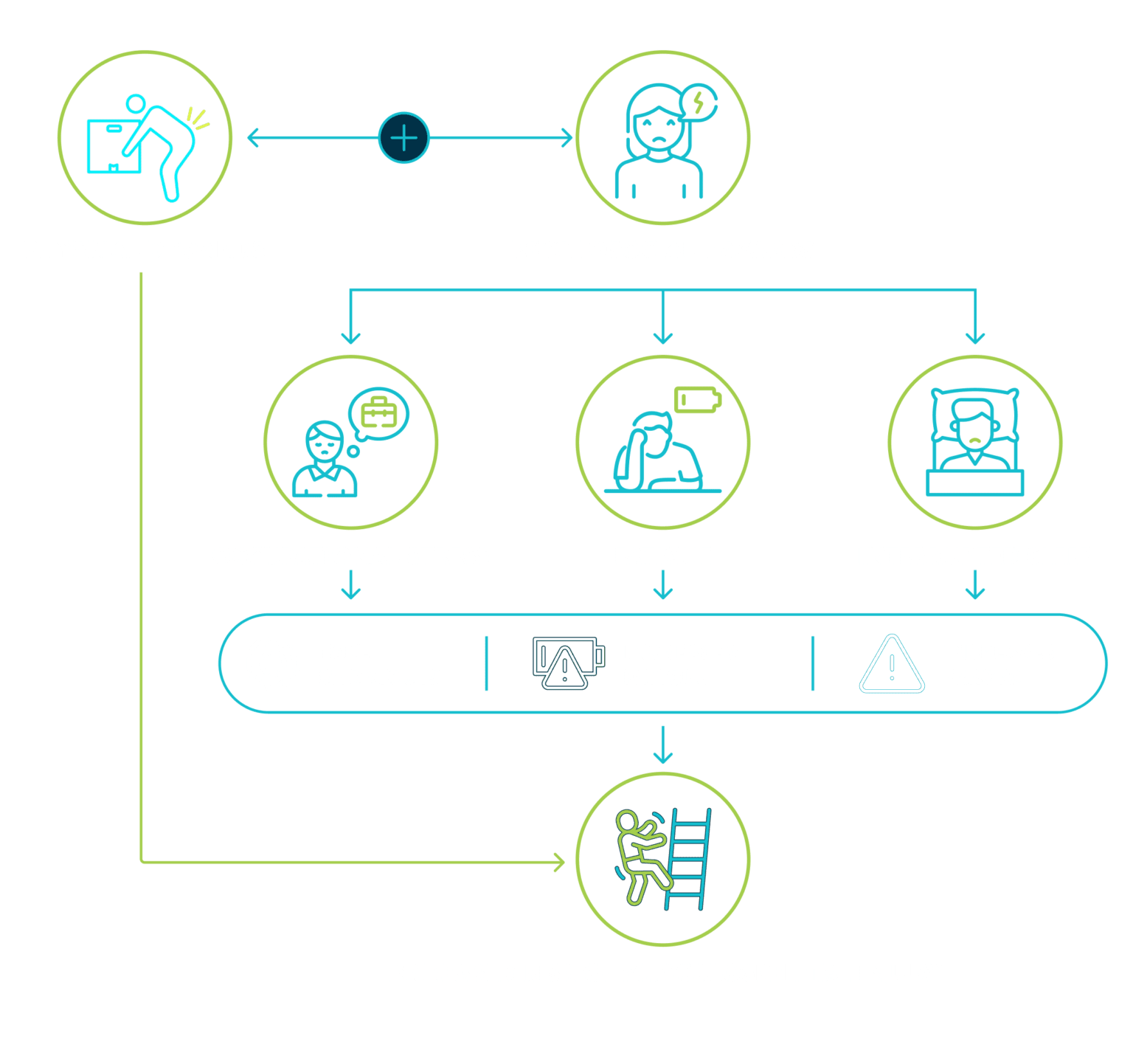
A study of 9,260 aluminium manufacturing workers found that those in jobs rated as high in psychological demand had a 49% greater risk of serious injury and serious MSD than those in low-demand jobs, even after adjusting for physical demand (Cantley et al., 2016). Low job control was also linked to higher risk of minor injury and minor MSD. The authors concluded that psychosocial exposures should be monitored alongside physical ones.
Note: the size of the effect may differ in other industries.
Psychosocial risk is easy to overlook because it often stays invisible until it appears in claims data. When it does, the numbers are significant.
Nationally, Safe Work Australia’s latest figures show that mental health conditions account for 12% of all serious workers’ compensation claims. That is up 161% over ten years, and the median time lost is almost five times that of other injuries and diseases.
When a physical injury becomes a psychological one, the impact is larger still. According to WorkSafe Queensland, secondary psychological injury claims cost five times more than a physical injury claim and involve almost triple the average time off work. Workers with these claims are away for an average of 303 days, and only 34.6% return to the role they held when the physical injury occurred.
WorkSafe Queensland also notes that secondary psychological injuries often develop when a worker feels unsupported, is left out of their recovery planning, or is uncertain about their future. Those are all things an employer can influence.
Culture plays a part too. Where there is no proactive safety culture, early MSD symptoms are easily ignored until they become severe, compensable tissue damage.
Under the model WHS laws, health includes both physical and psychological health, so the general duties already covered psychosocial risk. The newer regulations and Code of Practice spell out how to identify and control it.
Adoption differs by jurisdiction, because the regulations and Code must be implemented locally before they apply. NSW was the first to issue its code, in May 2021, and South Australia’s commenced on 19 February 2026. Check with your regulator which version applies to you. Courts may treat a code of practice as evidence of what is known about a hazard and what is reasonably practicable.
Consultation is a legal requirement (section 47 of the WHS Act), and it is also one of the most practical tools available. Psychosocial hazards aren’t always visible from a desk or a spreadsheet. The people doing the work usually see them first, and understanding their perspective is essential to mitigating the risk.
The Code of Practice notes that workers may use different terms to describe their exposure, and that surveys are one way to gather information from workers, HSRs, supervisors and managers. Where workers are represented by health and safety representatives, they must be included in consultation.
Because psychosocial risk isn’t always visible, it helps to look at indicators of three kinds:
Common assessment tools include the Psychological Safety Climate measure (PSC-12), COPSOQ and the APHIRM Toolkit.
Most MSD risk management focuses on physical hazards. The APHIRM toolkit, developed at La Trobe University, was built to address three gaps: risk from psychosocial hazards is often ignored, workers don’t participate enough, and controls often don’t tackle risk at its source.
Not all interventions are equal, and the biggest gains come from acting before harm occurs. The most effective measures are preventative: building a psychologically safe climate, designing jobs and systems that protect workers, strengthening manager capability and developing organisational resilience. Next come early interventions, such as health and wellbeing programs, which support workers before problems become serious.
At the other end are reactive measures like return-to-work processes and EAP services. They still matter, but they respond to harm that has already occurred, so their impact on the underlying risk is lower. Addressing the hazards themselves can prevent secondary psychological injuries, reduce the rate of MSDs, speed up return to work, lower compensation costs and improve engagement and productivity.
If your risk register treats them separately, you may be missing how they compound each other.
Look at the physical and psychosocial claims profile, and at turnover, absenteeism and grievances.
Consultation is a legal requirement and the best source of insight into hazards you can’t see.
Count how many of your controls are preventative, such as job design and manager capability, versus reactive.
Unsupported, excluded or uncertain workers are more likely to develop secondary psychological injuries.
Physical and psychosocial hazards are not two separate problems. High demands and low resources raise the risk of both psychological injury and musculoskeletal disorders, and the cost when they combine is far higher than either alone.
The legal direction is clear: manage psychosocial risk with the same rigour as any other hazard, alongside physical risk, with workers involved. The most effective way to do that is to prevent harm rather than respond to it.
If you’d like to understand how psychosocial and physical hazards interact in your workforce, or how the APHIRM process works in practice, we’d welcome the conversation.
Musculoskeletal disorder prevention is about more than lifting technique and posture. Research shows that physical
Musculoskeletal disorder prevention is about more than lifting technique and posture. Research shows that physical
Wondering how much an onsite physiotherapist costs? Learn typical pricing in Australia, what influences costs,
Remote work offers flexibility, but new research suggests it may also increase isolation and psychological
Tell us a little about your workplace and one of our specialists will be in touch to discuss the best options for your team.
"*" indicates required fields