
Free Resources:

We’ve created a set of practical, ready-to-use resources to help you support your workforce and reinforce healthier habits on-site.

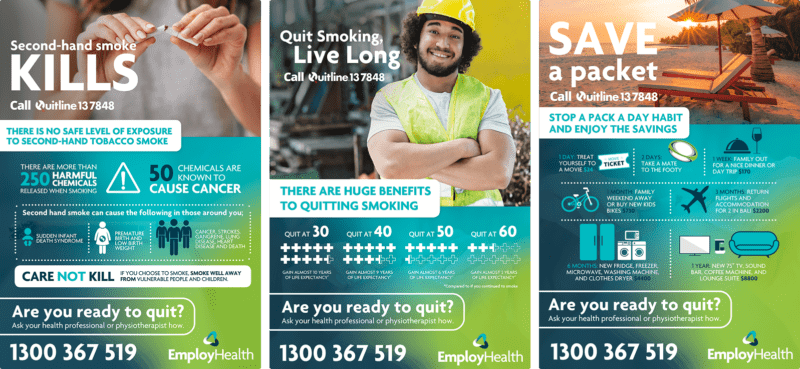
Download Workplace Posters Here: Ready-to-use posters designed for real worksites, simple, visible and effective.

Download Video Resource Here: A short, practical video you can share with your team to support awareness and engagement.

Burden of Tobacco Use

Every year on May 31, World No Tobacco Day highlights the health, social and economic burden of tobacco use. For blue-collar workplaces—including manufacturing, food processing, transport, warehousing, logistics, construction and heavy industry—this issue extends well beyond personal health. It affects productivity, attendance, safety, injury recovery, workforce capacity and operating costs. For employers managing tight rosters, physically demanding work and rising labour costs, reducing smoking and vaping can create meaningful business benefits.


Smoking Is a Business Issue, Not Just a Health Issue Smoking affects business performance in several ways.


1. Increased Absenteeism and Workplace Cost

Australian research estimated tobacco-related absenteeism and presenteeism cost workplaces approximately $4.98 billion per year, including 11.3 million extra days off work associated with smokers and ex-smokers. Workers who smoke daily were estimated to take 3.7 extra days off per year compared with workers who had never smoked (Whetton et al., 2019). The broader Australian social cost of smoking was estimated at $136.9 billion in 2015–16, including $19.2 billion in tangible costs and $117.7 billion in intangible costs (Whetton et al., 2019). For employers, these costs show up through sick leave, reduced output, rostering disruption, replacement labour and operational drag.


2. Reduced Productivity at Work

Even when workers are present, smoking can affect productivity through: smoking breaks, reduced respiratory capacity, fatigue, nicotine withdrawal, reduced stamina in physically demanding roles. International research found that smoking employees impose significant excess costs on employers. One study estimated the annual excess employer cost of a smoking employee at US$5,816, including absenteeism, presenteeism, smoking breaks and healthcare costs (Berman et al., 2014).

3. Higher Exposure in Some Blue-Collar Worker Groups

Australian worker data shows smoking reductions have not been evenly distributed. Daily smoking among Australian workers declined between 2007 and 2016, but reductions were lowest among men and non-metropolitan workers, with higher daily smoking rates in several lower socioeconomic and male worker groups (Roche et al., 2021). A related Australian study found daily smoking prevalence differed by industry and occupation, and that lower socioeconomic status and very high psychological distress were associated with increased odds of daily smoking (McEntee et al., 2021). This matters for blue-collar employers because smoking-related productivity and health risks may be concentrated in the same workforces already exposed to higher physical workload, shift work, fatigue and injury risk.

4. Slower Recovery and Injury Management Complexity

Smoking is associated with poorer wound healing and delayed bone healing. Reviews have found smoking adversely affects wound healing processes, and smokers have around twice the risk of non-union after fracture, spinal fusion, osteotomy, arthrodesis or treatment of non-union (Pearson et al., 2016; Sørensen, 2012). For employers, this may contribute to more complex recovery pathways, delayed return to full duties and greater rehabilitation demands.

What About Vaping?

While smoking rates have declined, vaping has increased substantially in Australia, especially among younger people. According to the Australian Institute of Health and Welfare, in 2022–23:

  • 8.3% of Australians aged 14+ smoked daily
  • 7.0% of Australians aged 14+ currently used e-cigarettes
  •  Around 49% of current e-cigarette users used them daily

Daily e-cigarette use rose from 0.5% in 2016 to 3.5% in 2022–23, equal to around 700,000 Australians (AIHW, 2024).

From a workplace perspective, vaping may create practical issues, including:

  • nicotine dependence during shifts
  • withdrawal symptoms affecting focus
  • additional break-taking
  • policy confusion where smoke-free rules do not clearly include vaping
  • respiratory irritation for some workers
  • higher relevance in younger workforce cohorts

The long-term health and productivity impacts of vaping are still emerging, so employers should avoid overstating the evidence. However, from a workforce-management perspective, vaping should be included in smoke-free and nicotine-dependence strategies.

Potential Business Benefits Why Reducing Smoking & Vaping Makes Commercial Sense

Helping workers reduce nicotine dependence should not be framed as punishment. It should be framed as a practical workforce health strategy.

Better Attendance

Reduced smoking-related illness and fewer avoidable absences.

Improved Productivity

Less time lost to smoking or vaping breaks and stronger work capacity during shifts.

Safer Operations

Better concentration, stamina and fatigue management.

Better Recovery Outcomes

Improved healing capacity may support stronger injury recovery and return-to-work outcomes.

Stronger Culture and Employer Brand

Visible investment in worker health supports retention, recruitment and trust.

Lower Long-Term Cost Pressure

Reduced health risk across the workforce can support lower absenteeism, reduced disruption and better operational resilience.

What Works Best in Blue-Collar Workplaces?

Generic awareness posters rarely shift behaviour. Industrial worksites respond better to practical, supportive strategies that are easy to access.

Effective Strategies Include:

  • onsite health checks
  • smoking and vaping cessation support
  • supervisor education
  • fatigue, sleep and lifestyle risk screening
  • incentive-based wellbeing campaigns
  • nicotine replacement referral pathways
  • clear smoke-free and vape-free site policies
  • data-led health initiatives targeting workforce risk

Where Employ Health Can Help

At Employ Health, we understand that blue-collar worksites need practical programs that improve both worker health and operational outcomes.

Our onsite workplace health services can support clients through:

  • workforce health screening
  • lifestyle risk identification
  • behaviour change coaching
  • fatigue management support
  • early intervention physiotherapy
  • injury prevention strategies
  • workforce data insights

The goal is simple: healthier workers, fewer disruptions and stronger performance.

Final Thoughts World No Tobacco Day Is a Good Time to Act

For blue-collar employers, reducing smoking and vaping is not just a well-being initiative. It is a productivity, safety and cost strategy. Even modest reductions in nicotine use across a workforce can create meaningful gains over time.

If your business wants to improve attendance, reduce injury burden and strengthen workforce performance, now is a smart time to act.

References

  1. Berman, M., Crane, R., Seiber, E., & Munur, M. (2014). Estimating the cost of a smoking employee. Tobacco Control, 23(5), 428–433.
  2. McEntee, A., Kim, S., Harrison, N., Chapman, J., & Roche, A. (2021). Patterns and prevalence of daily tobacco smoking in Australia by industry and occupation: 2007–2016. Nicotine & Tobacco Research, 23(12), 2047–2055.
  3. Pearson, R. G., Clement, R. G. E., Edwards, K. L., & Scammell, B. E. (2016). Do smokers have greater risk of delayed and non-union after fracture, osteotomy and arthrodesis? A systematic review. BMJ Open, 6(11).
  4. Roche, A., McEntee, A., Kim, S., & Chapman, J. (2021). Changing patterns and prevalence of daily tobacco smoking among Australian workers: 2007–2016. Australian and New Zealand Journal of Public Health, 45(3), 290–298.
  5. Sørensen, L. T. (2012). Wound healing and infection in surgery: The clinical impact of smoking and smoking cessation. Surgical Clinics of North America, 92(2), 229–240.
  6. Whetton, S., et al. (2019). Identifying the social costs of tobacco use to Australia in 2015/16. Curtin University.
  7. Australian Institute of Health and Welfare. (2024). Smoking and e-cigarettes in Australia.

Start your journey to Proactive Workplace Health

Call 1300 367 519